
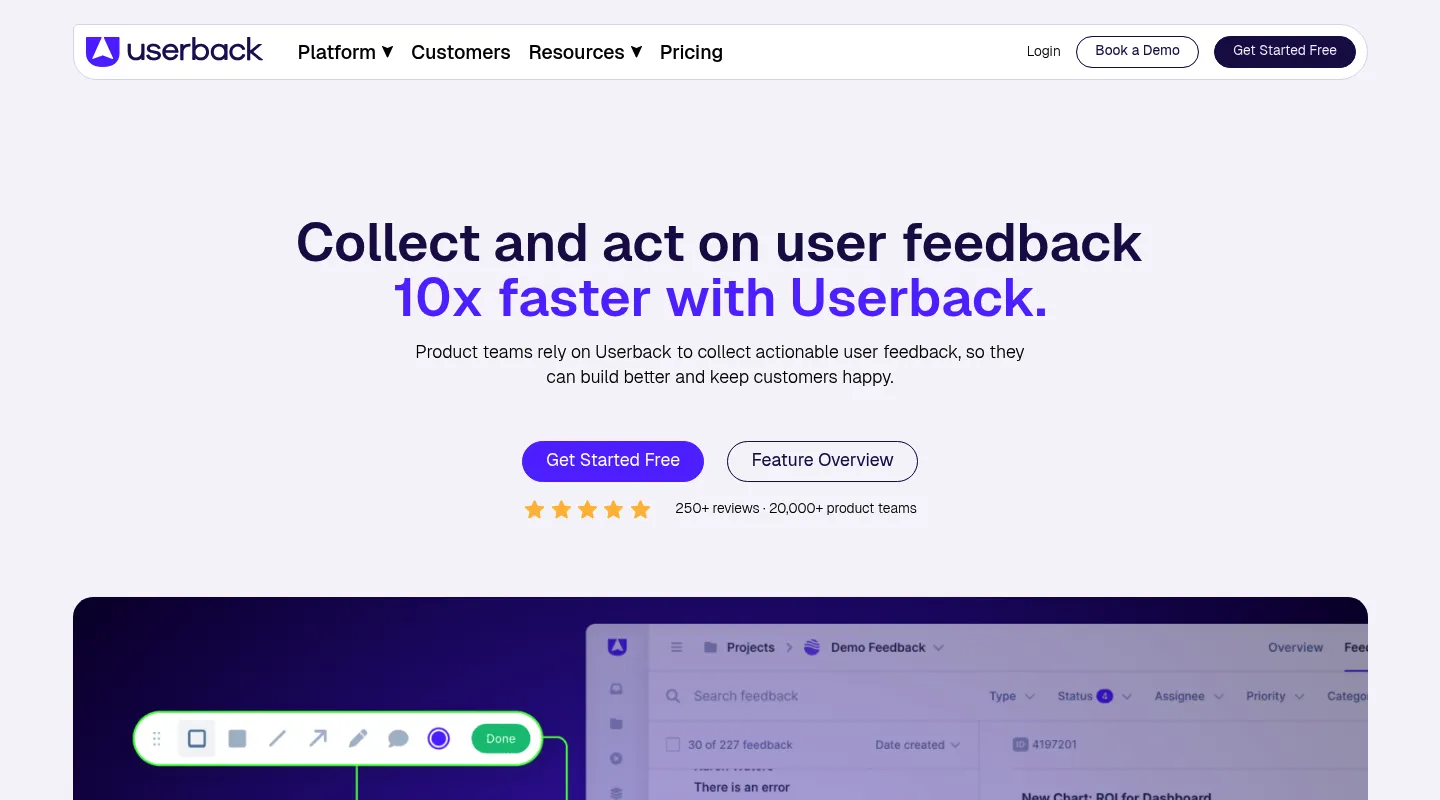
Huddlekit is the closest free Userback alternative for teams that need only the visual review half. Website projects need no widget or extension, there is a free plan for 3 team members with unlimited client guests, and responsive preview and CSS inspection instead of a full product-feedback suite. Userback is the better buy if you also want surveys, NPS, feature voting and a public roadmap in one place.
Userback packs a lot into one widget: visual annotation, surveys, NPS, feature voting, session replay, and a public roadmap. For a SaaS team gathering continuous product feedback, that breadth is the appeal. For a team that just needs a client to mark up a staging site, it's a whole platform wrapped around the one feature they came for — plus a widget on the site or an extension in every reviewer's browser before the first comment.
Most people weighing a Userback alternative come from one of two directions: they still want structured product feedback but find the suite heavier or costlier than the job calls for, or they run project-based client reviews and never needed surveys and roadmaps at all. This guide splits the best 2026 options along that line.
Why teams look for Userback alternatives
Userback is a website feedback and bug-tracking widget built for SaaS teams that want visual annotation bundled with a full product-feedback suite — surveys, NPS, feature voting, session replay, and a public roadmap. It's genuinely capable, but a few recurring frustrations send teams looking elsewhere:
- You're paying for a suite you don't touch: Surveys, NPS, feature voting, session replay, and roadmaps drive the price — dead weight if you just need visual feedback on a site.
- Something to install first: Userback collects through a JavaScript widget on the site or a browser extension each reviewer adds. Either way, setup comes before the first comment, which is awkward on client-owned sites.
- The free plan runs out fast: The no-cost tier covers 2 seats and 2 projects and keeps feedback for only 7 days. Team is $29/month billed yearly ($39 monthly), and session replay, surveys, and console logs start at Business, $79/month billed yearly ($99 monthly).
- Built for products, not projects: It's designed around ongoing SaaS feedback, not the one-off client reviews agencies and freelancers run.
- Every unused module adds friction: Surveys, roadmaps, and replay you never touch are still there to configure and learn.
What to look for in a Userback alternative
Weigh the replacement against the job Userback was really doing for you:
- Product feedback, or just visual review? Answer this first — it decides which tools below are even worth a look.
- Install model: A widget or reviewer extension (Userback-style) versus URL access with nothing to install.
- Project work versus continuous feedback: One-off client reviews, or an always-on product-feedback loop.
- Pricing shape: Which tier the features you actually use sit on, and how the price moves as your team grows.
- Client experience: Whether a non-technical reviewer can leave feedback without an account or login.
Best Userback alternatives compared
1. Huddlekit — Best if you never needed the product-feedback suite
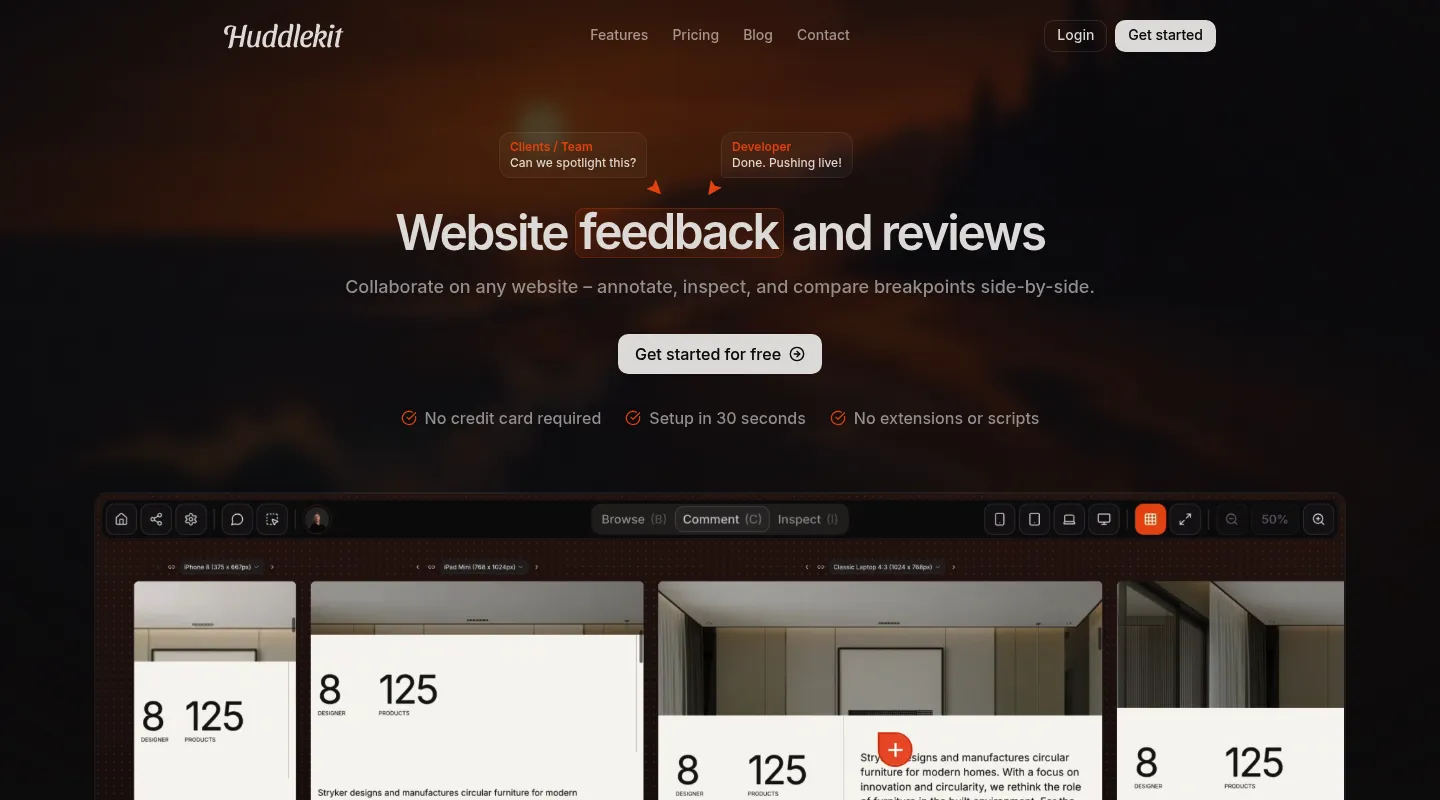
If your actual work is project-based website review — agencies, freelancers, and design teams collecting client sign-off — Huddlekit gives you the visual annotation Userback is built on, without the surveys, roadmaps, and replay stacked on top.
Key differences from Userback:
- Nothing to install for website projects: Pages open from a URL — paste a link and share it. No widget on the client's site and no extension for reviewers.
- Context attached automatically: Browser, viewport, device, and element details ride along with every comment — the practical metadata, minus the session replay.
- No product-feedback bloat: Visual commenting, CSS inspection, and breakpoint switching on every plan, plus a side-by-side canvas on Pro and Team, without paying for NPS boards and roadmaps.
- More than live sites: Collect feedback on documents, images, and videos too, not only websites.
- Its own task board: A built-in Kanban turns comments into tracked work without an export step.
- Or your tracker, on Team: Send comments to Linear, ClickUp, Notion, or Trello with status synced both ways, or to Asana with completion synced both ways, alongside Slack notifications, Zapier, webhooks, and the API.
- Hand comments to an AI agent: On Pro and Team, Claude, Claude Code, or Cursor connect over MCP to read feedback with its element and screenshot, fix the code, and resolve the comment.
- Clients just comment: Reviewers leave feedback with no account, login, or onboarding.
Pricing: Free plan available (1 project, 3 members). Paid plans from $16/month billed yearly ($19 monthly); Pro covers 3 members, unlimited projects, and 5 GB storage, and Team adds 15 seats and 50 GB for $33/month yearly ($39 monthly). Every paid plan carries a 30-day money-back guarantee.
Pros:
- Nothing to install for website projects
- Focused feature set, far cheaper for feedback-only work
- Responsive preview and CSS inspection built in
- Free plan plus a 30-day money-back guarantee
Cons:
- No surveys, NPS, or feature voting
- No session replay
- No native Jira integration (Zapier on Team covers it)
Verdict: When surveys and roadmaps were never why you signed up, Huddlekit delivers Userback's visual capture for project work at a fraction of the cost — and with nothing to install.
Best for: Agencies, freelancers, and design teams running client website reviews.
"I love this tool! The UI is super intuitive and clean, and the best part is being able to see all the breakpoints side by side." — Mikael, Product Designer @ Team Blue
Visual website feedback, minus the product-feedback platform.
Try Huddlekit2. Usersnap — Best if you want to keep surveys and NPS, with enterprise compliance
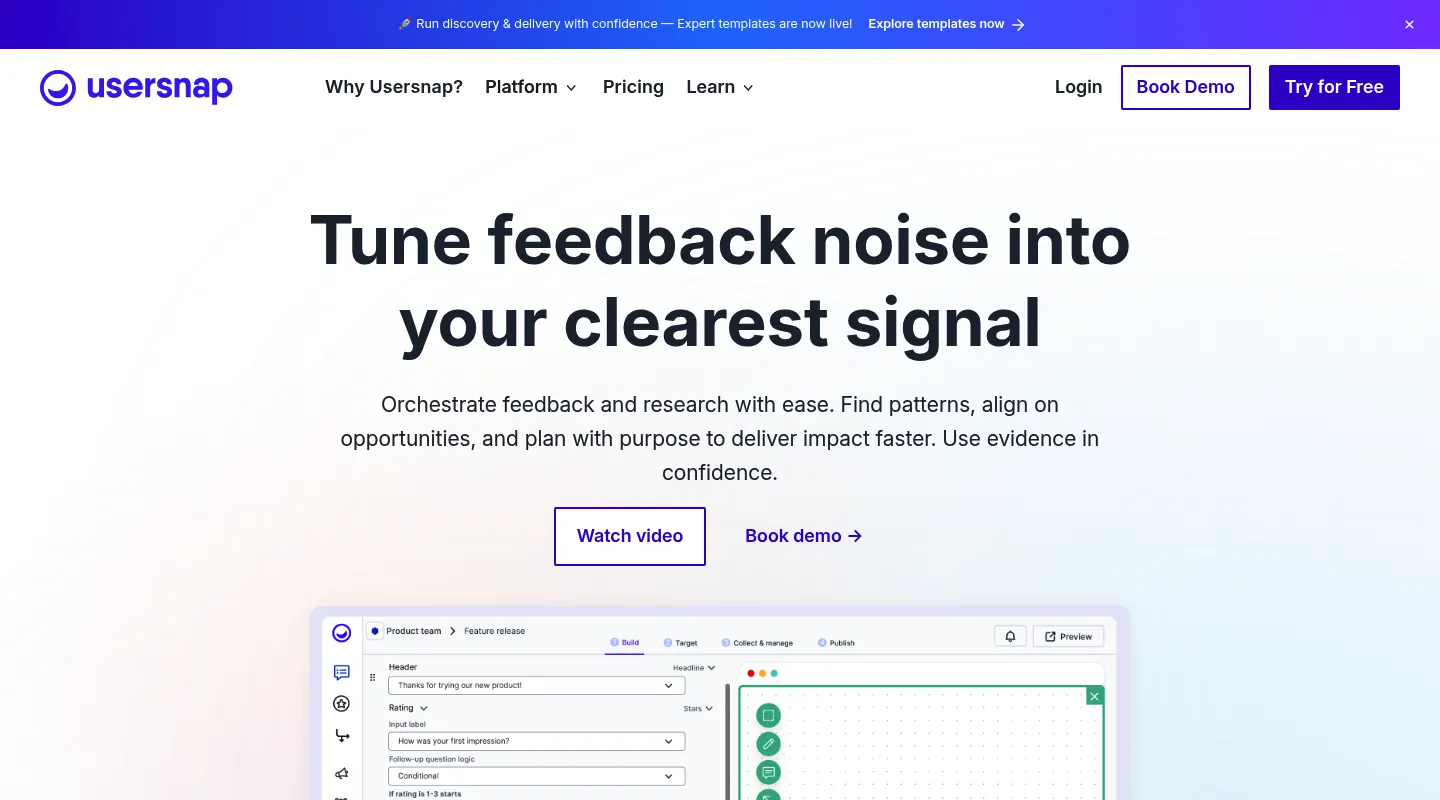
Userback and Usersnap sit in the same category — both pair visual bug capture with a product-feedback suite. If you're leaving Userback but genuinely use the surveys and NPS and need enterprise compliance on top, Usersnap is the closest like-for-like here.
Key differences from Userback:
- Enterprise compliance: GDPR and CCPA controls aimed at larger organisations.
- Detailed technical capture: Console logs, network requests, and environment data with each bug report.
- Full survey layer: In-product surveys, micro-surveys, NPS, and feature-request boards sit alongside the visual capture.
- No permanent free plan: Where Userback has a free tier, new Usersnap accounts get Premium access only until they've collected their first 20 feedback items.
- Same install options: Like Userback, it collects through a JavaScript widget on the site or a browser extension.
Pricing: No permanent free plan (Premium access for your first 20 feedback items). Starter is €39/month billed yearly (€49 monthly); Growth is €89 (€109 monthly), Professional €159 (€199), and Premium from €319 (€389).
Pros:
- Surveys, NPS, and bug capture in one platform
- Enterprise compliance controls
- Detailed technical capture for developers
Cons:
- No permanent free plan; the Premium trial ends after 20 feedback items
- A higher entry price than Userback's Team plan
- Pricing climbs steeply at the higher tiers
Best for: Enterprise product teams that want the survey-and-NPS suite plus GDPR/CCPA compliance — and will actually use it.
3. Marker.io — Best for deep developer debugging
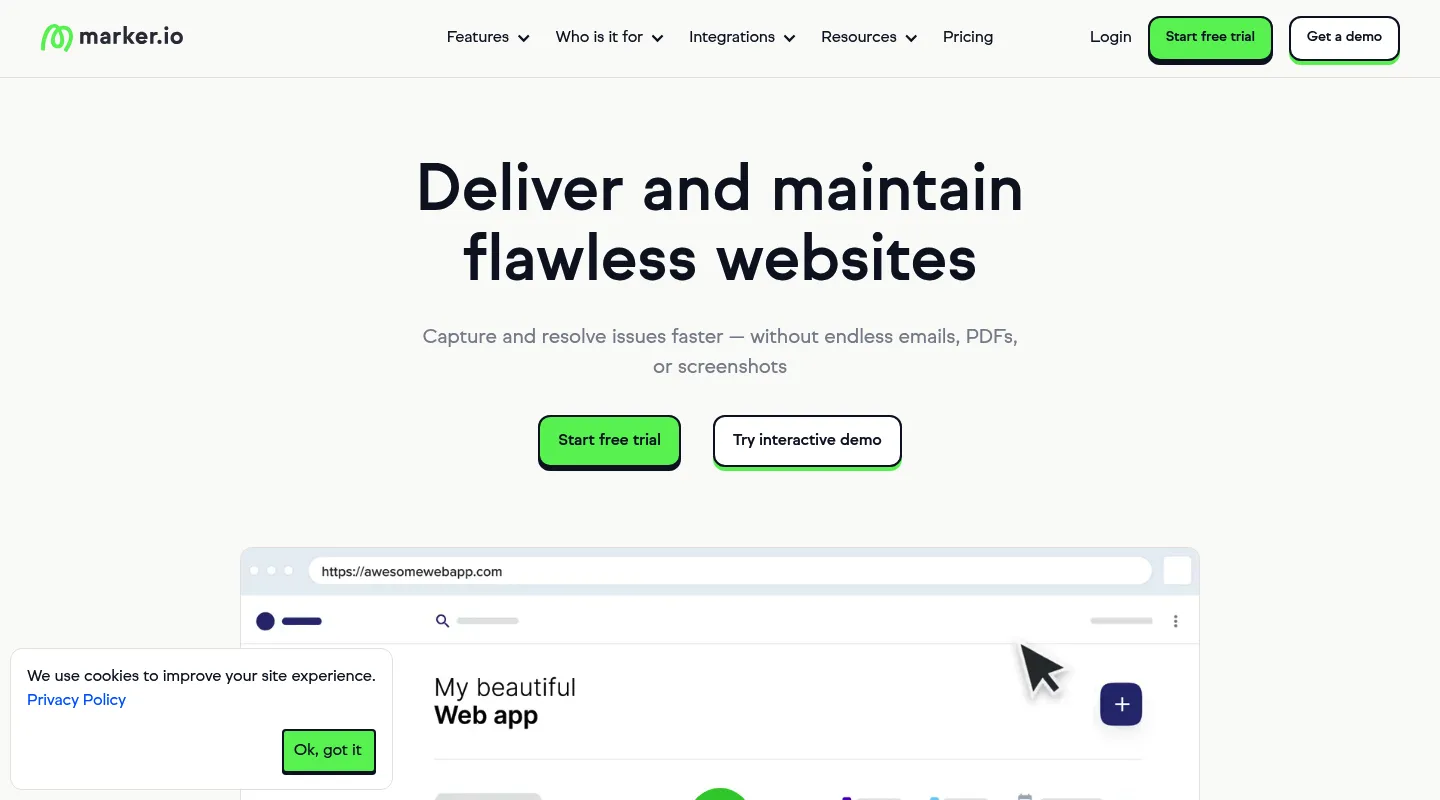
Where Userback spreads across surveys and roadmaps, Marker.io narrows to one job: capture a bug with full technical context and route it straight into your issue tracker.
Key differences from Userback:
- Deep technical capture (Team plan): Console logs, network requests, and environment data on every report, alongside session replay.
- Two-way issue-tracker sync (Team plan): Real bidirectional integration with Jira, GitHub, GitLab, and Asana.
- No product-feedback layer: Purely bug reporting — none of Userback's surveys, NPS, or feature voting.
- Similar install options: A JavaScript snippet, a no-code WordPress plugin, or a browser extension, and there's no free plan.
Pricing: No free plan. Starter is $39/month billed yearly ($59 monthly) for 3 users, with screenshots, environment details, and basic integrations. Session replay, console and network logs, and two-way sync start at Team, $149/month billed yearly ($199 monthly).
Pros:
- Strong technical debugging with session replay (Team)
- Best-in-class dev-tool integrations
- Focused, with no survey overhead
Cons:
- A snippet, plugin, or extension to set up
- The debugging depth sits on the $149+/month Team plan, and there's no free plan
- Overkill if you don't live in Jira or GitHub
Best for: Development teams whose reports need to land directly in Jira or GitHub with full technical context.
4. BugHerd — Best for turning feedback into managed tasks
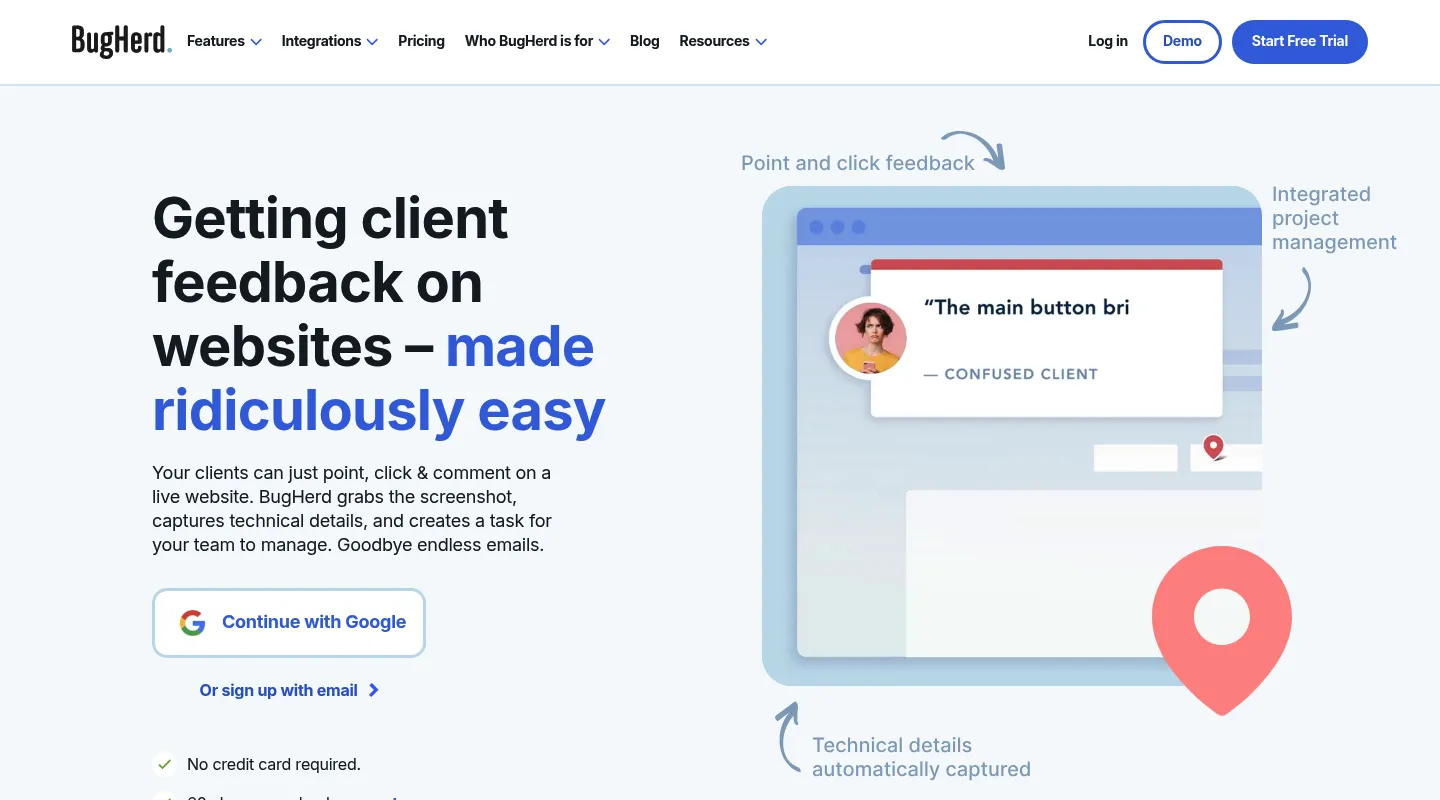
BugHerd pairs point-and-click feedback with a built-in Kanban board, so client comments become triaged cards — the project-management angle Userback doesn't emphasise.
Key differences from Userback:
- Feedback becomes a board: Comments land on an integrated Kanban you manage without exporting.
- Client collaboration mode: A stripped-down surface for non-technical reviewers.
- Lighter metadata: Captures browser, OS, and screen details automatically, but no session replay.
- No survey suite: Built around bug-and-task tracking, not NPS, feature voting, or roadmaps. Standard includes Trello, Slack, GitHub, and Zapier; Jira, Asana, Linear, ClickUp, and Monday start at Premium ($150/month).
Pricing: No free plan; free trial. From $50/month for 5 members ($42/month billed annually).
Pros:
- Built-in task management
- Predictable flat team pricing
- Mature integrations from a long-established tool
Cons:
- Needs a snippet on the site or an extension for each reviewer
- No responsive testing or CSS inspection
- No surveys, NPS, or session replay
Best for: Agencies that want feedback capture and task tracking living in one place.
5. Ybug — Best lightweight, low-cost bug capture
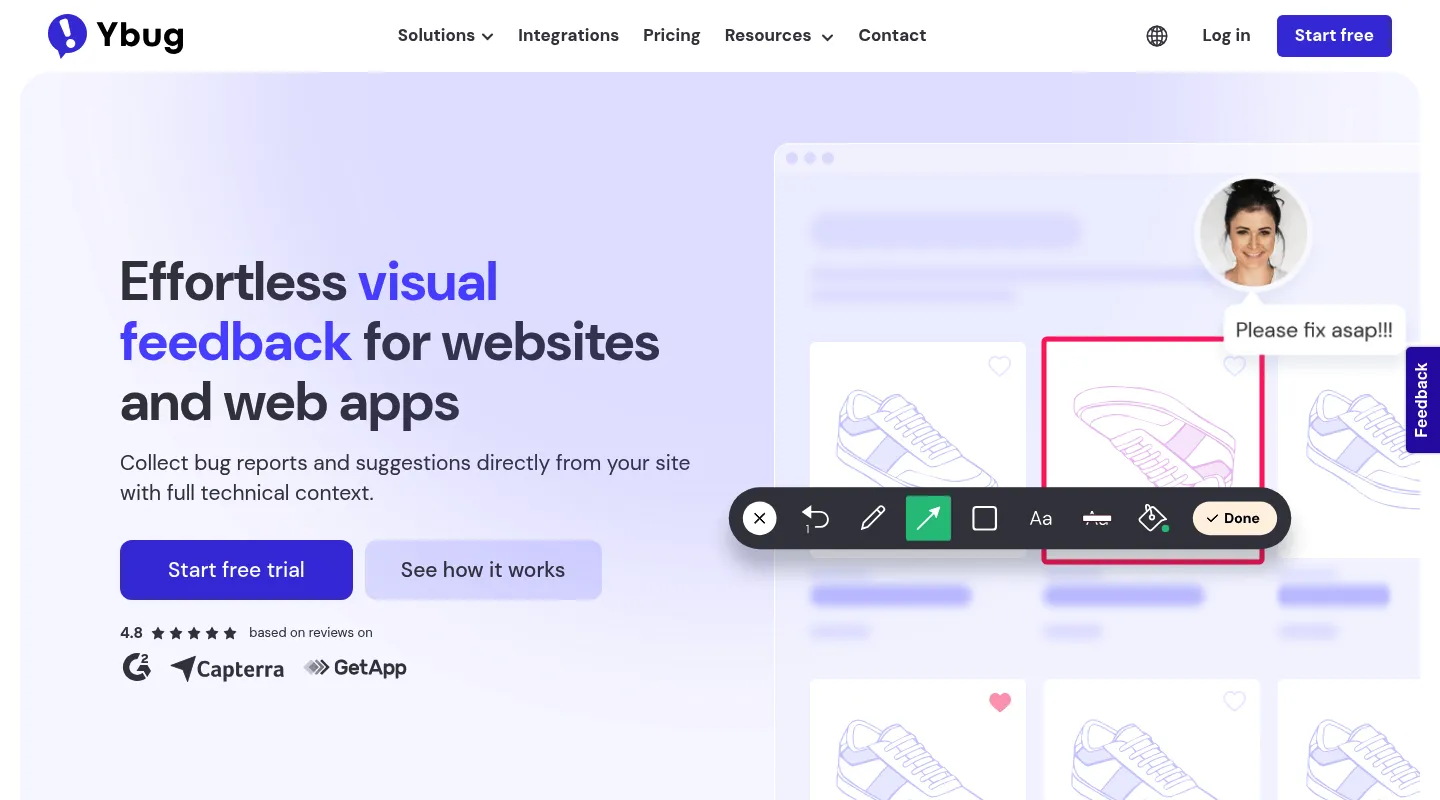
If you want Userback's screenshot-and-metadata capture pared to the essentials — and priced to match — Ybug is the lean option: annotated bug capture done well, product-feedback suite skipped entirely.
Key differences from Userback:
- Plug-and-play capture: Annotated screenshots with browser, OS, screen size, URL, and console logs.
- Bug-first scope: Built for reporting and reproducing issues, not surveys or roadmaps.
- Much lower cost: Paid plans open at €10/month billed annually — a fraction of Userback.
- Snippet or extension: A JavaScript snippet or browser extension collects the feedback.
Pricing: Free plan available (1 project, 1 user). Paid plans from €10/month billed annually (€13 monthly), scaling to €47/month for 15 members.
Pros:
- Very affordable, with a free tier
- Solid technical capture for developers
- Quick to set up
Cons:
- Requires a widget or extension
- No responsive preview or CSS inspection
- Bug-reporting focus, thin on design workflows
Best for: Small teams that want technical bug capture without paying for a full feedback platform.
When to stick with Userback
Userback earns its price if:
- You're a SaaS product team collecting ongoing user feedback
- You genuinely run surveys, NPS, and feature voting
- Session replay is central to how you reproduce and understand reports
- You want a public roadmap and changelog to close the loop with users
When to switch — and to what
- You never used the surveys or NPS → Huddlekit (project website reviews) or Ybug (lean bug capture)
- You want to keep surveys and NPS, with compliance → Usersnap
- You need Jira/GitHub-native debugging → Marker.io
- You want feedback plus a task board → BugHerd or Huddlekit
- You don't want a widget or reviewer extension, or you need responsive testing and CSS inspection → Huddlekit
- Paying for a product-feedback suite is the dealbreaker → Huddlekit or Ybug
Making the switch
Moving off Userback is straightforward:
- Export any essential feedback from Userback for your records
- Pull the Userback widget or extension off your sites and browsers
- Spin up your new tool and set up the workspace
- Invite your team and rebuild the review workflow
- Send fresh review links to your clients
With Huddlekit, website projects have no install step — share a URL and clients can comment the same minute. Check our pricing to see the difference, or contact us with questions.
Ready to trade the widget for a shareable link?
Get startedFrequently asked questions
Is Userback free?
Userback has a free plan, but it's tightly limited: 2 seats, 2 projects, and feedback kept for 7 days. Paid plans start with Team at $29/month billed yearly ($39 monthly), and session replay, surveys, and console logs start at Business, $79/month billed yearly ($99 monthly). If you only need visual website feedback — not surveys, NPS, and roadmaps — Huddlekit's free plan includes 1 project and 3 members, and Pro is $16/month billed yearly for exactly the capture you'll use.
Is Userback overkill for website feedback?
Often, yes. Userback is a full product-feedback platform built for SaaS teams gathering feedback continuously. On project-based website reviews most of that suite goes untouched, while a focused tool like Huddlekit covers visual commenting, responsive preview, and CSS inspection without it.
Does Userback require installing code on my site?
Not necessarily, but something has to be installed. Userback's main route is a JavaScript widget on the site, which needs code access; it also offers a browser extension that each reviewer installs instead. Huddlekit's website projects run from a URL — paste a link and clients start commenting, with nothing on the site and nothing in the reviewer's browser.
What's the closest alternative to Userback?
For a like-for-like product-feedback platform, Usersnap is the nearest match — it keeps surveys, NPS, and detailed bug capture, with enterprise compliance, though it has no permanent free plan to match Userback's. If you don't actually use those features, Huddlekit (for website reviews) or Ybug (for lean bug capture) deliver the visual capture for far less.
Conclusion
Userback is a strong platform, but most of its price is the surveys, NPS, session replay, and roadmap suite built around the visual capture. If that suite isn't part of your workflow, you're paying for it regardless.
Sort your choice by what you need: Usersnap for the survey suite with enterprise compliance, Marker.io for Jira/GitHub-native debugging, BugHerd for feedback-as-tasks, Ybug for lean low-cost capture — and Huddlekit if you're doing project-based website reviews and never needed a product-feedback platform at all.
See Huddlekit's plans or reach out to talk through your workflow.
Want the wider field? Our guide to the best website annotation tools compares Userback against the alternatives.