

Website annotation tools have transformed how teams review and approve websites. Instead of vague emails like "the button looks weird on my phone," you can pin comments directly to specific elements, capture technical context automatically, and keep all feedback organized in one place.
But with dozens of tools claiming to solve the same problem, choosing the right one is harder than it should be. The differences between tools are real — installation method, client experience, device support, and pricing model all affect whether a tool actually gets used or abandoned in favor of email.
This guide reviews 12 website annotation tools in detail, comparing features, verified pricing, installation methods, and ideal use cases. Whether you run a design agency collaborating with clients or an internal team doing QA, you will find the tool that fits your workflow.
Quick answer
If you only have 30 seconds:
- Best for agency-client reviews: Huddlekit — no-install proxy, multi-device canvas (Pro and Team), guest access without login.
- Best for developer QA: Marker.io — on its Team plan, captures console logs and network data and syncs two-way with Jira.
- Best for product feedback inside a live app: Userback — script-tag widget with session replay and surveys.
- Best free starting point: Huddlekit Free (1 project, 3 team members — designed to test on a real project), Userback Free, or Pastel Free.
The rest of this guide explains why each tool fits its category, with verified 2026 pricing and the trade-offs that matter when you put a tool in front of real clients or teammates.
At-a-glance comparison
| Tool | Best for | Starting price | Free plan | Installation | Mobile testing |
|---|---|---|---|---|---|
| Huddlekit | Agency-client reviews across devices | $16/mo | Yes (1 project, 3 members) | Proxy / script tag | Canvas view (Pro and Team) |
| Marker.io | Developer QA with technical metadata | $39/mo | No (15-day trial) | Snippet / WP plugin / extension | No |
| BugHerd | Agency task management | $50/mo | No (free trial) | Script tag / extension | No |
| MarkUp.io | Public site annotations + file reviews | $79/mo | No (14-day trial) | Proxy | No |
| Userback | Product feedback + session replay | $29/mo | Yes (2 seats) | Script tag / extension | No |
| Pastel | Website + design file reviews | $35/mo | Yes (limited) | Proxy | Responsive tester (one view at a time) |
| Zipboard | Multilingual reviews | $99/mo | No (15-day trial) | Proxy / script tag | No |
| Usersnap | Bug reporting on web apps | €39/mo | No | Script tag / extension | No |
| Filestage | Approval workflows + file reviews | $199/mo | Yes (limited) | URL-based | No |
| Markup Hero | Simple screenshot annotation | $7/mo | Yes | Extension / desktop app | No |
| Atarim | WordPress agencies | $67/mo | Yes (limited) | URL / extension / WP plugin | No |
| Verbalio | Budget-friendly basic annotation | €9/mo | No | Script tag | No |
What is a website annotation tool?
A website annotation tool lets you mark up live websites with comments, pins, highlights, and feedback — similar to reviewing a PDF or design file, but directly on the real, interactive page.
Instead of taking screenshots, editing them in a separate app, and sending unclear Slack messages, you can:
- Pin comments directly to specific elements on a live webpage
- Capture technical context automatically (browser, screen size, URL, scroll position, console errors)
- Collaborate with teammates and stakeholders in threaded discussions
- Track feedback status from submission through to resolution
These tools are essential for website launches, ongoing QA, client review cycles, and responsive design testing.
How to choose a website annotation tool
Before comparing tools, understand which factors actually determine whether a tool works for your team.
1. Installation method
How a tool accesses your website is the single most important technical decision. It determines who can use it, what devices work, and how much friction your reviewers face.
| Method | How it works | Pros | Cons |
|---|---|---|---|
| Browser extension | Reviewer installs a Chrome/Firefox plugin | Works on any site including authenticated staging | Every reviewer must install it; desktop only |
| Proxy / embed | Tool loads your site through its own URL | No installation for reviewers; instant setup | Pages behind a user login need another method; may break dynamic sites |
| Script tag | You add a code snippet to your site's HTML | Works on authenticated pages; supports mobile; nothing for reviewers to install | Requires developer access to add the script |
Some tools offer multiple methods. Huddlekit uses a proxy for website projects (no install — site passwords and basic auth work through it) and a script tag widget for web apps behind a user login.
2. Client-friendliness
If you work with non-technical clients, the tool must be simple enough that they can leave their first comment within 30 seconds of opening the link. Complex tools get abandoned in favor of email, defeating the purpose entirely.
Critical factors:
- No login or account creation required for reviewers
- Intuitive click-to-comment interface
- Mobile support for reviewing responsive layouts
- Clear visual indicators of comment status
3. Integration ecosystem
Most teams already use project management tools (Linear, Jira, Asana, ClickUp). The best annotation tools sync feedback directly into your existing workflow. Pay attention to whether integrations are one-way (notifications only) or two-way (feedback automatically creates and updates issues).
4. Collaboration features
Annotation is just the first step. You also need:
- Threaded discussions on each comment
- @mentions and email notifications
- File attachments for additional context
- Status tracking (open, in progress, resolved)
- Priority levels for triage
- Public/private visibility controls for internal notes
5. Pricing structure
Watch out for:
- Per-user pricing scales faster than you expect when you add freelancers and clients
- Guest access costs — some tools charge for external collaborators
- Feature gating — critical features (mobile testing, integrations) locked to higher tiers
- Project limits on lower tiers that force upgrades quickly
12 best website annotation tools (2026)
1. Huddlekit
Best for: Agencies, design teams, and freelancers who need client-friendly reviews across all devices
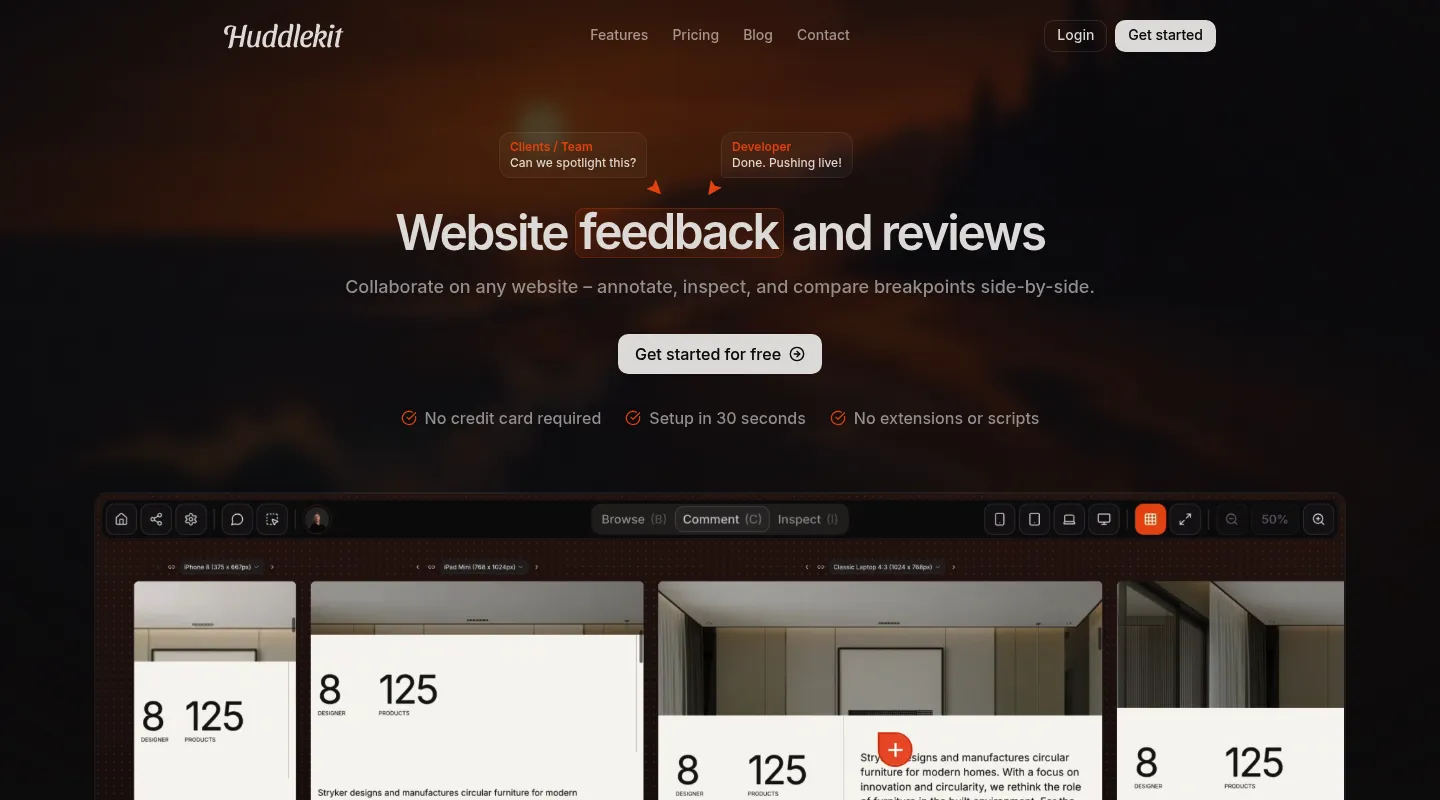
Huddlekit is a website annotation and feedback workspace that loads your site through a secure proxy, so reviewers comment directly on the real page without installing anything. It is the only tool in this guide with a multi-device canvas view for reviewing responsive layouts (on the Pro and Team plans).
Key features:
- Pin comments directly on live websites with visual markers anchored to specific elements
- Canvas view (Pro and Team) — see your site at mobile, tablet, laptop, and desktop widths side by side, each frame set from device presets: mobile (280–540px), tablet (768–1024px), laptop (1024–1600px), desktop (1280–2560px)
- Built-in inspect mode showing element sizes, spacing, typography, and colors — without opening browser DevTools (for team members; guests on share links don't get it)
- Review media assets (images, PDFs, videos) alongside website projects
- Guest access with no login required — tokenized share links for clients
- Comment statuses (Open, In Review, In Progress, Resolved) with drag-and-drop kanban board
- Priority levels (Critical, Medium, Low), custom tags, public/private comments, @mentions
- File attachments on comments (images and PDFs, up to 5 per comment)
- Web app widget — script tag for authenticated pages with platform-specific guides for React, Next.js, WordPress, Webflow, Wix, Squarespace, Shopify, and Framer
- Integrations: Linear, ClickUp, Notion, Asana, Trello, Slack, Zapier, webhooks, and API access on Team; MCP for AI tools on Pro and Team
Installation: Proxy (no install for website projects; site passwords and basic auth work) or script tag widget (for web apps behind a user login)
Pricing:
- Free: 1 project, up to 3 team members — for trying Huddlekit on a real project
- Pro: $16/mo (billed yearly) — 3 team members, unlimited projects, 5 GB storage
- Team: $33/mo (billed yearly) — 15 team members, unlimited projects, 50 GB storage
Monthly billing available at $19 for Pro and $39 for Team. All paid plans include unlimited guests and comments, plus a 30-day money-back guarantee. View Huddlekit pricing for a full plan breakdown.
Pros:
✅ Only tool with multi-device canvas view (4 breakpoints side by side, Pro and Team) ✅ Built-in inspect mode for sizes, spacing, typography, and colors ✅ No reviewer login or installation required ✅ Unlimited guests on all plans — no per-seat cost for client access ✅ Modern, fast interface that non-technical clients use without instructions
Cons:
❌ Smaller integration ecosystem than enterprise tools (no native Jira or GitHub sync yet — those go through Zapier on Team) ❌ Newer to market with evolving feature set
Best use cases: Web agencies reviewing client projects, freelancers collecting feedback on staging sites, design teams testing responsive layouts, QA teams validating cross-device experiences.
Annotate websites across every device — no installs, no logins.
Try Huddlekit2. Marker.io
Best for: Development teams doing internal QA with deep technical metadata capture
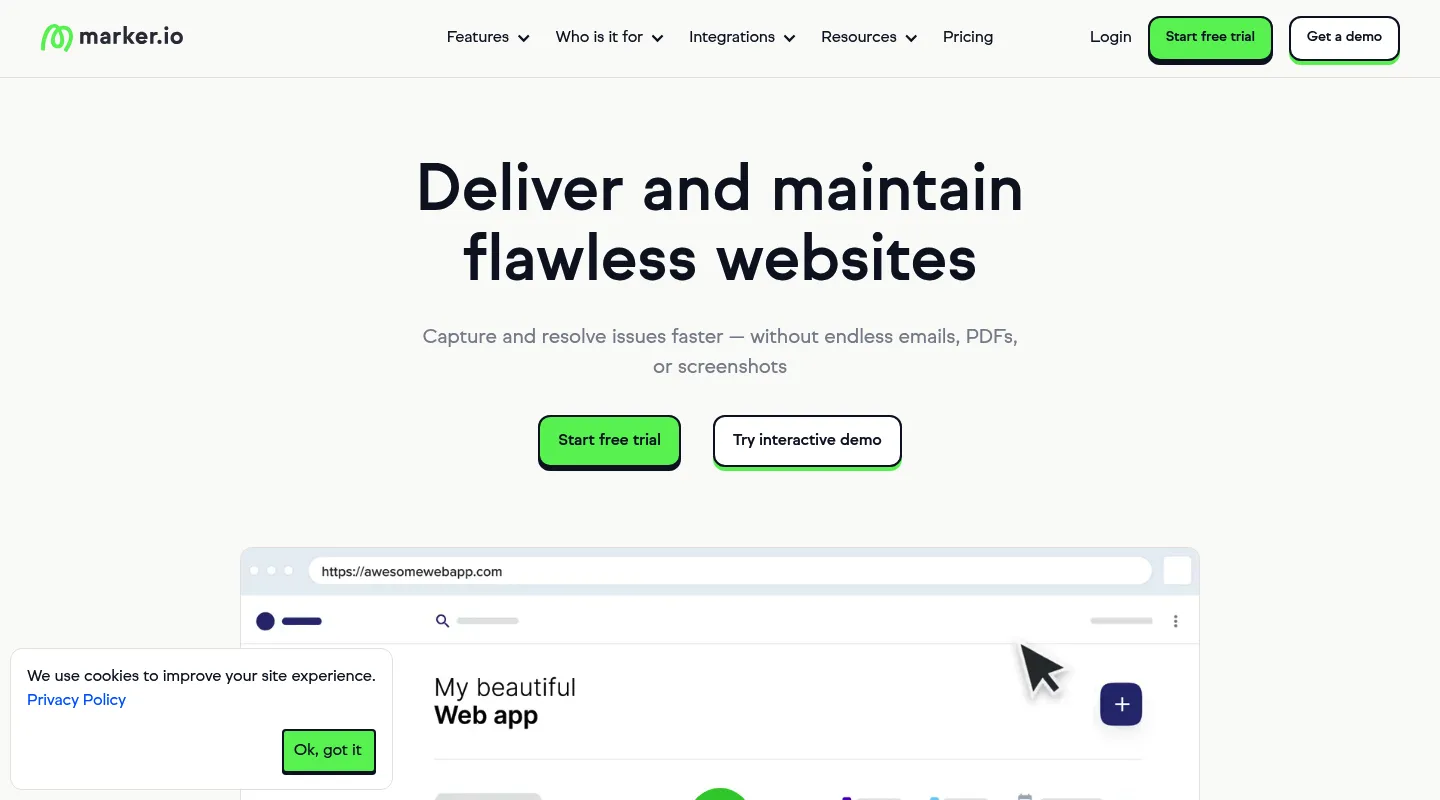
Marker.io is a developer-first annotation tool that captures detailed technical context — environment data on every plan, plus console logs and network requests from the Team plan up — alongside visual feedback. It installs as a JavaScript snippet, a no-code WordPress plugin, or a browser extension, so it works on any site, including behind authentication.
Key features:
- Feedback widget via JavaScript snippet, WordPress plugin, or browser extension
- Automatic capture of console logs and network requests (Team plan and up)
- Screen capture with annotation
- Customizable feedback forms with required fields
- Session replay for reproducing reported bugs (Team plan and up)
- Jira integration and two-way issue sync (Team plan and up)
- Guests report through the on-site widget (no extension needed)
Installation: JavaScript snippet, no-code WordPress plugin, or browser extension (Chrome, Firefox, Edge)
Pricing:
- Starter: $39/mo billed yearly ($59 monthly) — 3 users, up to 10 projects, 10 guests; screenshots, environment details, basic integrations
- Team: $149/mo billed yearly ($199 monthly) — 15 users, up to 50 projects, 50 guests; session replay, console and network logs, Jira and two-way issue sync
- Agency: $99/mo billed yearly ($129 monthly) — for qualifying agencies; 15 users, 50 projects, 50 guests
- Business: Custom (annual only)
- 15-day free trial, no credit card required
Pros:
✅ Best-in-class technical metadata capture (console logs, network data) on Team ✅ Two-way Jira sync on Team — real sync, not just notifications ✅ Screen capture and environment details on every plan ✅ Customizable forms reduce back-and-forth clarification
Cons:
❌ Needs a snippet or plugin on your site (or an extension per reviewer) — no install-free share link ❌ Console logs, session replay, and two-way sync start at Team ($149/mo billed yearly) ❌ No responsive breakpoint testing or multi-device canvas ❌ Can feel overwhelming for non-technical clients
Best use cases: Internal QA teams, developer bug reporting, SaaS product feedback, teams already using Jira or GitHub as their primary issue tracker.
3. BugHerd
Best for: Web agencies managing client feedback with Kanban-style task management
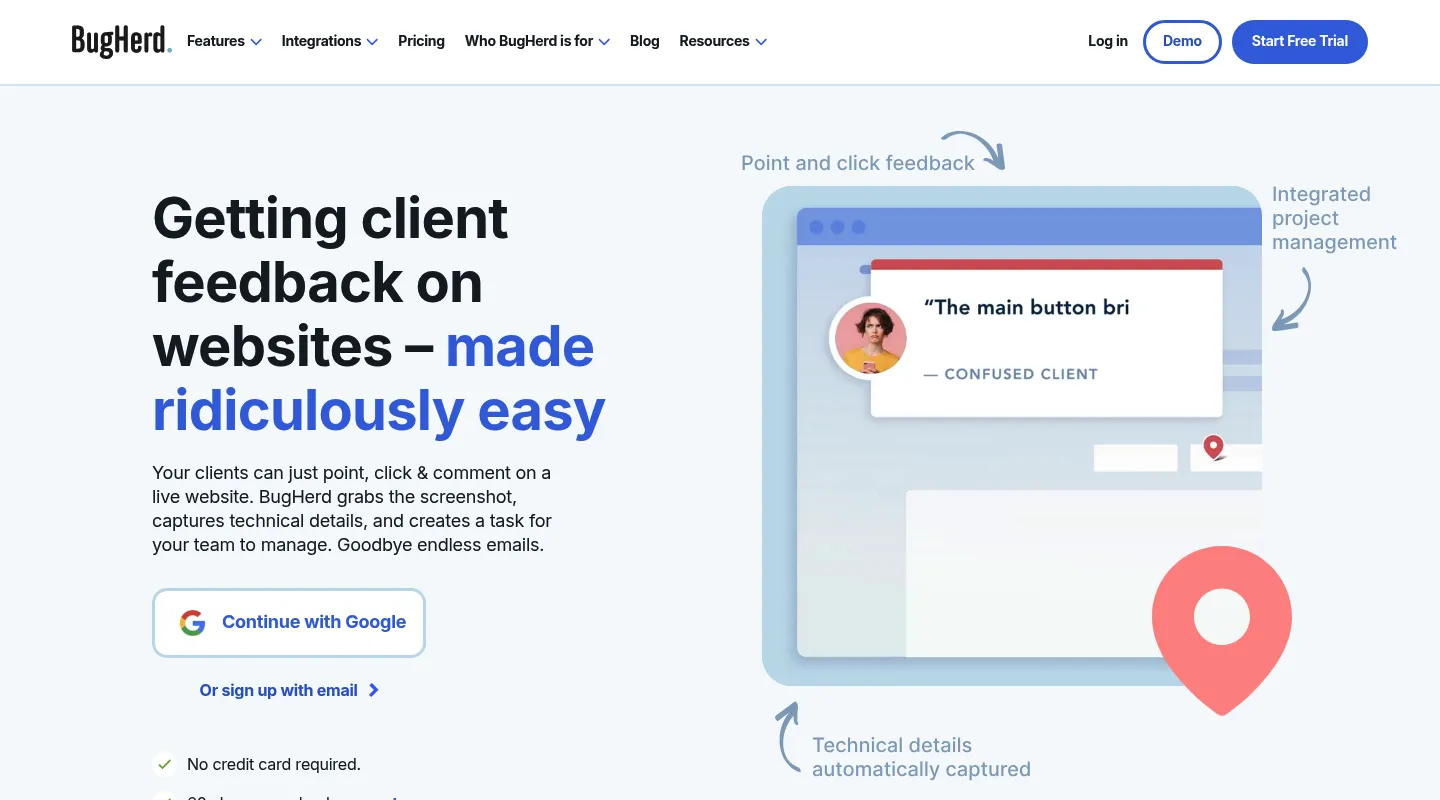
BugHerd has been a go-to tool for agencies for over a decade, combining visual website annotation with a built-in Kanban task board. It uses a JavaScript snippet installed on your site, or a browser extension for each reviewer if you can't add code.
Key features:
- Click-to-comment interface on live websites
- Built-in Kanban board with customizable columns for task management
- Automatic browser metadata capture (browser, OS, screen resolution, and the element the feedback is pinned to)
- Client-friendly guest mode with no login required
- Feedback on Figma files, PDFs, and images (recently added)
- Video feedback recording
- Integrations: Trello, Slack, GitHub, and Zapier on Standard; Jira, Asana, Linear, ClickUp, and Monday on Premium and up
Installation: Script tag on your site, or a browser extension for each reviewer
Pricing:
- Standard: $50/mo — 5 members, unlimited projects
- Studio: $80/mo — 10 members
- Premium: $150/mo — 25 members, adds Jira, Asana, Linear, and ClickUp
- Custom: Contact for pricing
- Free trial, 60-day money-back guarantee. Additional members: $8/mo each.
Pros:
✅ Unlimited projects on all plans ✅ Strong built-in Kanban task management ✅ Mature product with proven agency workflows ✅ Broad integration list (GitHub on Standard; Jira and Asana on Premium)
Cons:
❌ Needs a script on your site or an extension for each reviewer (no proxy option for quick reviews) ❌ No multi-device canvas or responsive breakpoint testing ❌ Interface design shows its age compared to newer tools ❌ Member limits on lower tiers with $8/mo per additional member
Best use cases: Established agencies with many concurrent client projects, teams that want Kanban task management built into their feedback tool.
4. MarkUp.io
Best for: Annotating public websites and reviewing 30+ file types without any installation
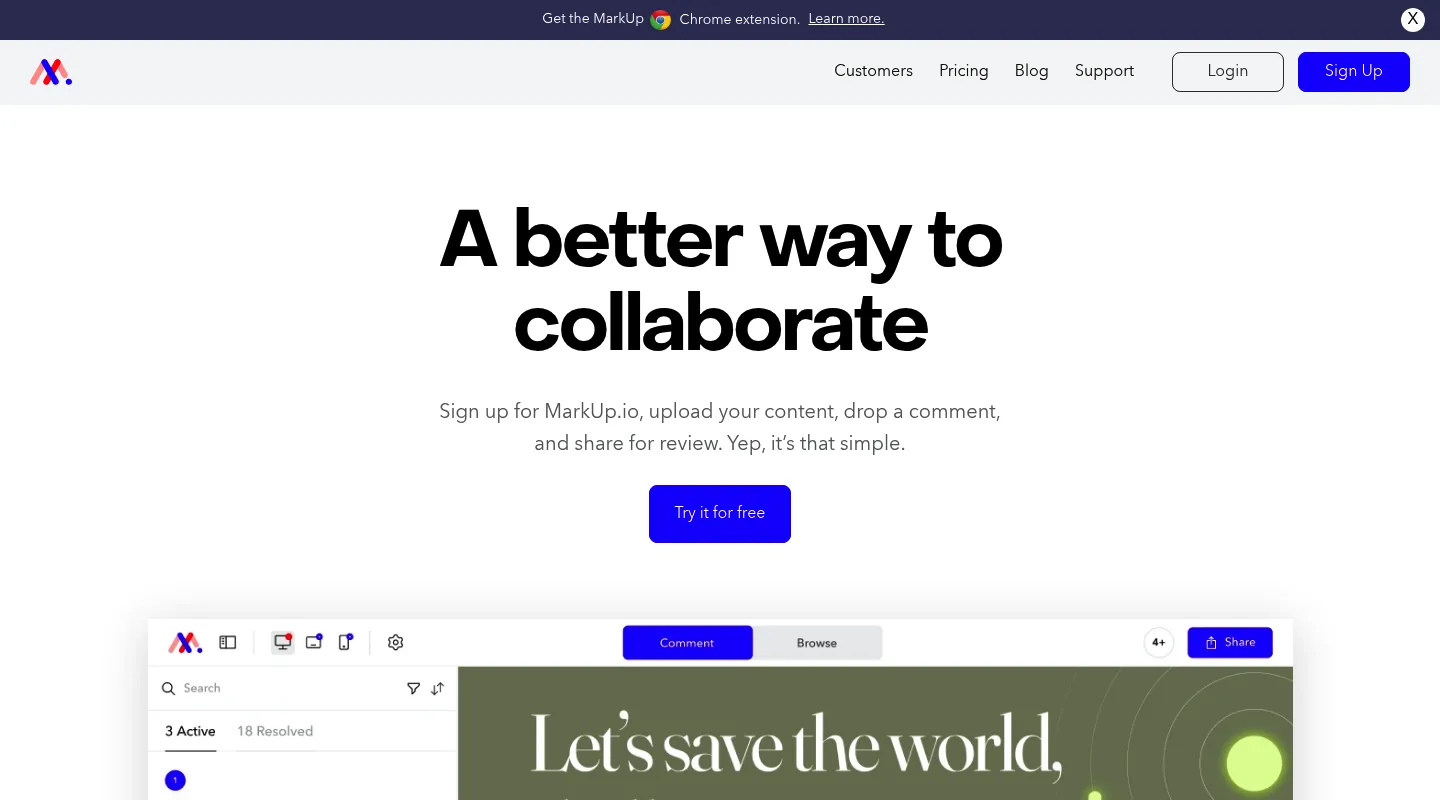
MarkUp.io uses a proxy approach to load any public URL for annotation. It also supports over 30 file types — images, PDFs, videos, audio, HTML — making it one of the most versatile tools for mixed content reviews.
Key features:
- Instant URL annotation via proxy — paste a URL and start commenting
- Support for 30+ file types including video with timestamped comments
- Drawing tools, arrows, shapes, and text annotations
- Threaded collaboration and discussions
- Integrations: Slack, Trello, Asana, Jira, Monday.com
Installation: None (proxy-based for websites, upload for files)
Pricing:
- Pro: $79–$129/mo — unlimited users, 50–100 MarkUps (review files) per month
- Enterprise: Custom — unlimited storage and workspaces, SSO, SOC II
- 14-day free trial. No free plan.
Pros:
✅ Zero installation — works instantly on any public URL ✅ Unlimited users on Pro plan (no per-seat pricing) ✅ Supports 30+ file types beyond websites ✅ Simple, approachable interface
Cons:
❌ Cannot access password-protected staging environments ❌ Proxy can break JavaScript-heavy dynamic sites ❌ No responsive breakpoint testing or mobile views ❌ No free plan — 14-day trial only ❌ Monthly cap of 50–100 MarkUps on Pro
Best use cases: Competitive analysis, public website reviews, teams reviewing mixed content types (websites, PDFs, videos) in a single tool.
5. Userback
Best for: Product teams combining website annotation with session replay and user feedback
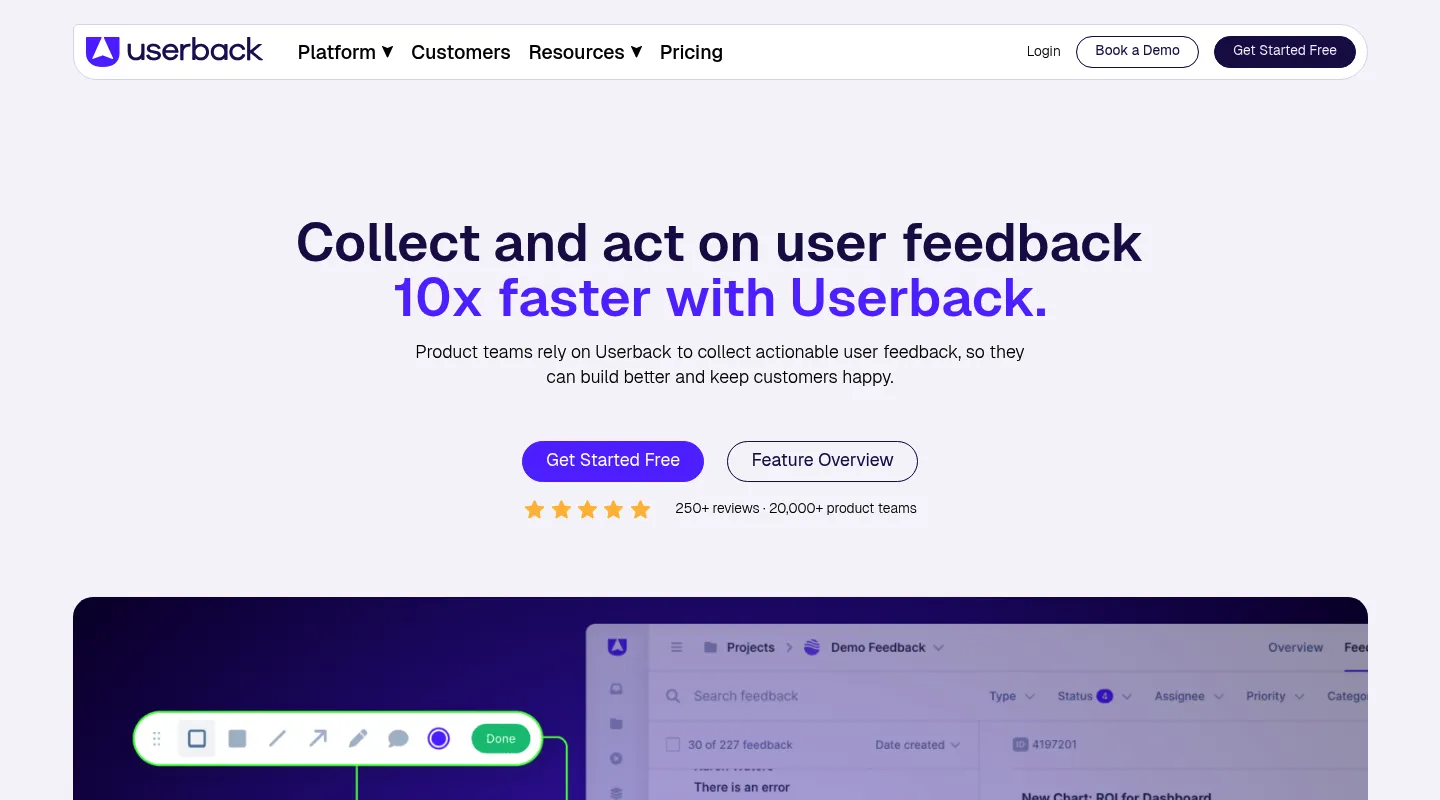
Userback goes beyond annotation to include session replay, surveys, and feature voting. It is built for product teams that want to understand the full picture of how users interact with their product.
Key features:
- In-app feedback widget with visual annotation and screenshots
- Session replay and user recordings
- User satisfaction surveys (NPS, CSAT)
- Feature voting boards for roadmap input
- AI-powered feedback categorization
- Integrations: Jira, GitHub, Slack, Trello, Azure DevOps, Linear, Intercom
Installation: Script tag (embedded on your site) or browser extension
Pricing:
- Free: $0 — 2 seats, 2 projects, 7-day feedback retention
- Team: $29/mo billed yearly ($39 monthly) — 5 seats, flat rate
- Business: $79/mo billed yearly ($99 monthly) — session replay, surveys, console logs
- Business Plus: $159/mo billed yearly ($199 monthly)
Pros:
✅ Comprehensive platform — feedback, session replay, surveys, feature voting in one tool ✅ Free plan for getting started ✅ AI-powered feedback categorization ✅ Strong integration ecosystem
Cons:
❌ Free plan keeps feedback for only 7 days ❌ Overkill if you only need website annotation ❌ Session replay, surveys, and console logs only from Business ($79/mo billed yearly) ❌ Learning curve to configure all features
Best use cases: SaaS products collecting end-user feedback, product teams running user research, companies that want feedback collection and analytics in one platform.
6. Pastel
Best for: Teams reviewing both websites and design files in one tool
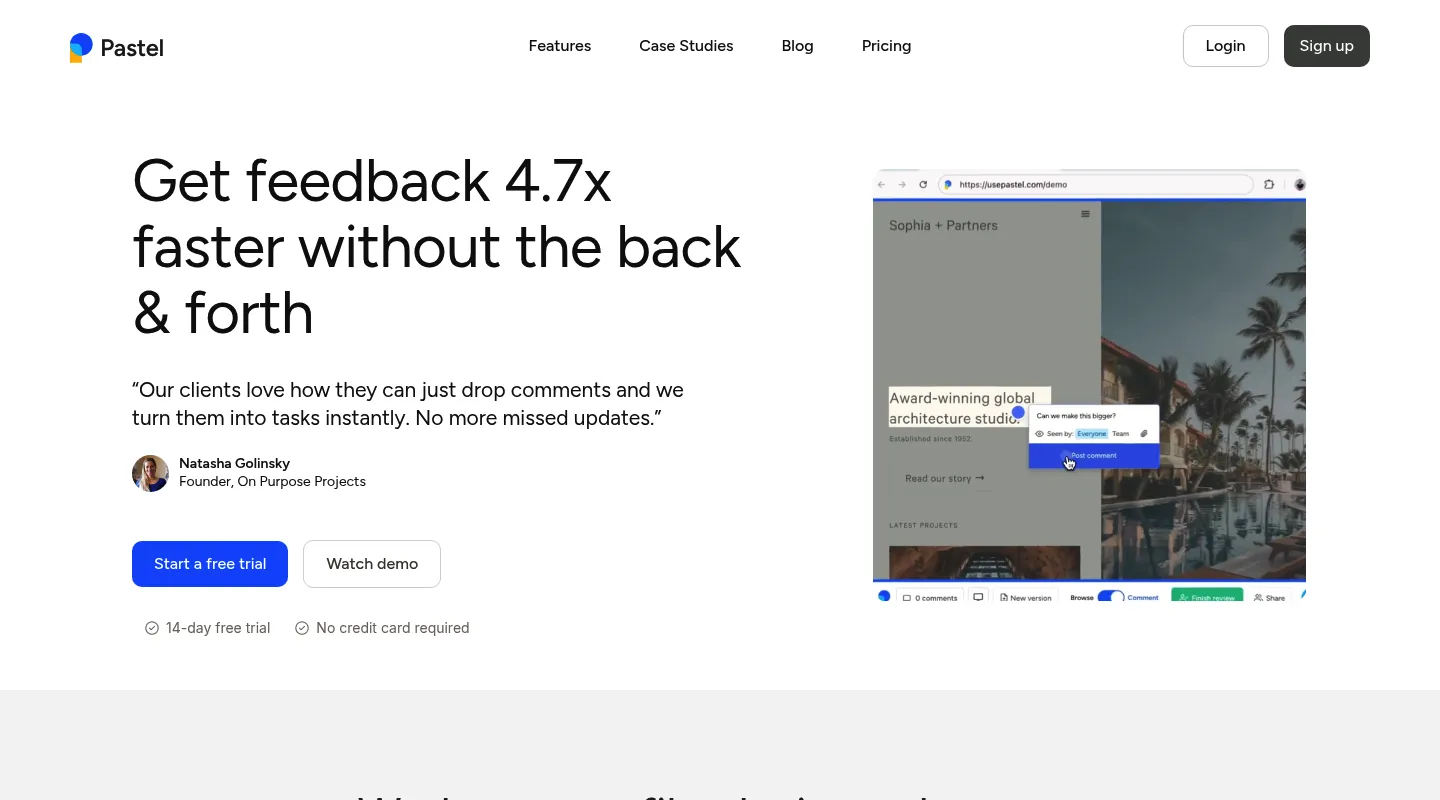
Pastel bridges website annotation with design file reviews, handling both live sites (via proxy) and static assets (images, PDFs, videos) with approval workflows.
Key features:
- Website annotation via proxy (any public URL)
- Responsive tester for switching between mobile, tablet, and desktop views (including on Free)
- Design file reviews (images, PDFs, videos)
- Version comparison for tracking changes
- Approval workflows with sign-off tracking
- Guest commenting without login
Installation: None for websites (proxy-based), upload for files
Pricing:
- Free Forever: $0 — 1 user, 1 active canvas, 2 GB video storage
- Pro: $35/mo — 2 users, 3 active canvases, 100 GB storage
- Team: $119/mo — 5 users, unlimited canvases (extra users $24/user/mo)
- Enterprise: $450/mo — 10 users, SSO, SOC 2
- 14-day free trial on paid plans
Pros:
✅ Handles websites and creative files in one tool ✅ Free plan for solo users ✅ Clean, intuitive interface ✅ Good approval workflow for client sign-offs
Cons:
❌ Proxy cannot access password-protected staging sites ❌ No side-by-side breakpoint view (the responsive tester shows one view at a time) ❌ Per-user pricing scales fast on Team plan ($24/user) ❌ Active canvas limits on lower tiers (1 on Free, 3 on Pro)
Best use cases: Small design agencies reviewing both sites and mockups, freelancers managing client approvals, teams that need one tool for mixed content.
7. Zipboard
Best for: Enterprise teams managing multilingual reviews and localization QA
Zipboard specializes in visual feedback with localization and multi-language review features that most annotation tools ignore entirely.
Key features:
- Website and web app annotation
- Localization workflow support with multi-language reviews
- Support for eLearning content (SCORM, xAPI)
- Task management with priority and status tracking
- Integrations: Jira, Slack, Trello, Asana, Microsoft Teams
Installation: Script tag or proxy
Pricing:
- Team: $99/mo — up to 20 digital asset pieces, 1 GB storage, unlimited collaborators
- Agency: $199/mo — up to 100 asset uploads, up to 5 managers
- Enterprise: Custom
- No free plan — 15-day trial on all plans
Pros:
✅ Strong localization and multi-language review features ✅ Supports eLearning content formats (SCORM, xAPI) ✅ Good for international teams with multi-language sites ✅ Comprehensive task management
Cons:
❌ Complex for teams with simple annotation needs ❌ Higher pricing than comparable tools ❌ Localization features wasted if you only work in one language ❌ Steeper learning curve
Best use cases: Enterprise teams with multilingual websites, eLearning companies, global agencies doing localization QA.
8. Usersnap
Best for: Bug tracking and structured feedback collection on web applications
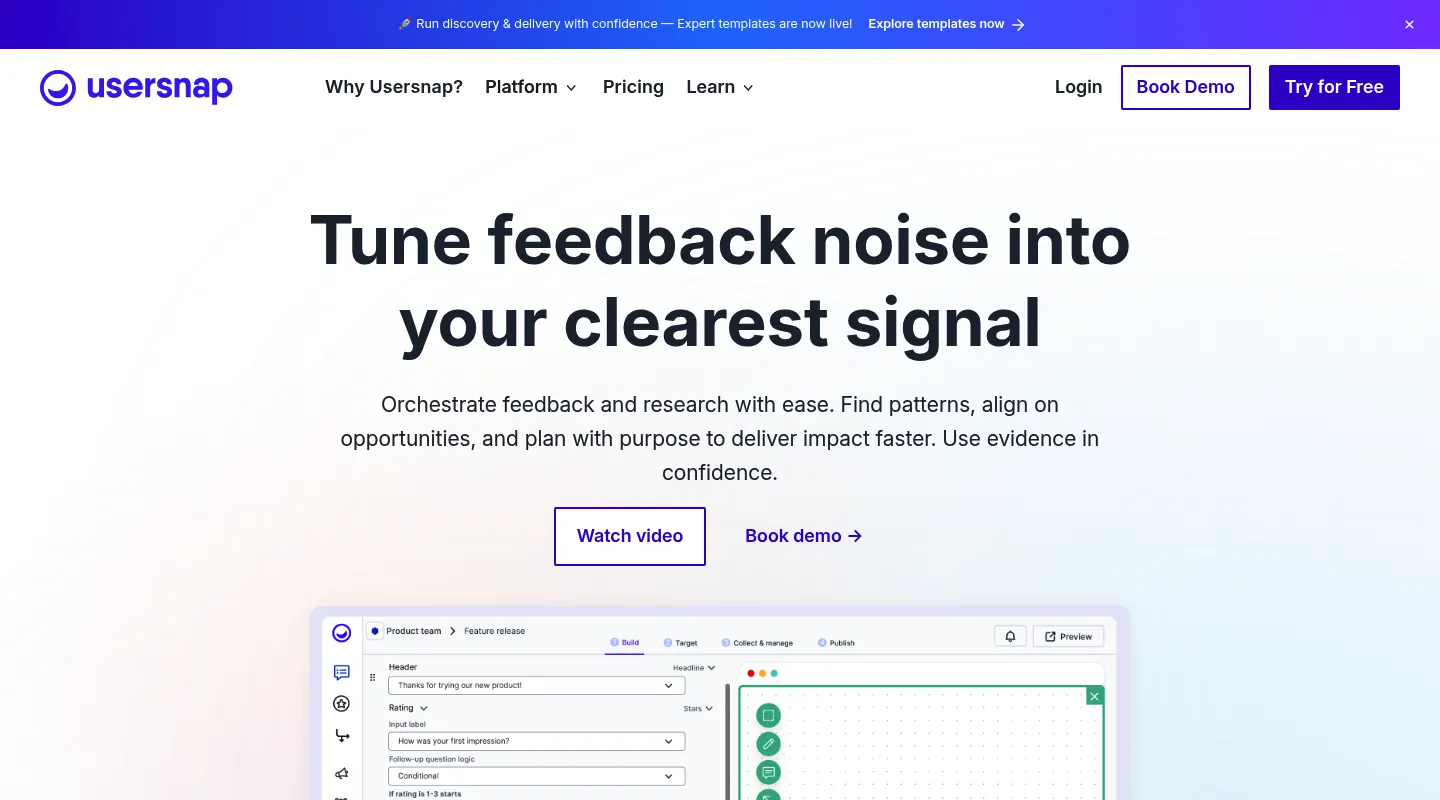
Usersnap combines bug tracking with user feedback collection and microsurveys. Its strength is capturing technical context alongside visual feedback for development teams.
Key features:
- Screenshot annotation with drawing tools
- Screen recording
- Microsurveys, NPS, and satisfaction ratings
- Console log and metadata capture
- Customizable feedback forms and workflows
- Integrations: Jira, GitHub, Slack, Azure DevOps, Zendesk, Intercom
Installation: Script tag or browser extension
Pricing:
- Starter: €39/mo billed yearly (€49 monthly; $49/$59 USD)
- Growth: €89/mo billed yearly (€109 monthly)
- Professional: €159/mo billed yearly (€199 monthly)
- Premium: from €319/mo billed yearly (€389 monthly)
- No permanent free plan — new accounts get Premium access until they've collected their first 20 feedback items
Pros:
✅ Strong technical metadata for developer bug reports ✅ Screen recording on paid plans ✅ Mature product with enterprise features ✅ Customizable feedback forms
Cons:
❌ Pricing can be high, particularly in EUR markets ❌ Team member limits on all tiers ❌ Complex for teams that just need simple annotation ❌ No permanent free plan — the free Premium access ends after 20 feedback items
Best use cases: Software teams tracking bugs, QA departments, product teams combining feedback collection with bug reporting.
9. Filestage
Best for: Creative teams managing approval workflows across websites and media assets
Filestage is primarily a review and approval platform for creative assets, but it also supports website annotation via URL loading. Its strength is multi-stage approval workflows.
Key features:
- Website review via URL loading
- Support for video, images, PDFs, audio, and documents
- Multi-stage approval workflows with reviewer groups
- Version comparison (side-by-side)
- Automated reminders for pending approvals
- AI-powered review assistance (Business plan)
- Integrations: Slack, Microsoft Teams, Zapier
Installation: URL-based (no code installation)
Pricing:
- Free: $0 — 1 active project, 5 files/month, 10 team members
- Starter: $199/mo — unlimited projects and files, 1 TB storage
- Business: $329/mo — 3 TB, AI reviewers, automations, API access
- Enterprise: Custom — SSO, audit logs, dedicated support
Pros:
✅ Broadest file format support — websites, video, images, PDFs, audio, documents ✅ Mature multi-stage approval workflows ✅ White-label options for agency branding ✅ Free plan includes 10 team members
Cons:
❌ Expensive — Starter is $199/mo ❌ Overkill if you only need website annotation ❌ Free plan limited to 1 project and 5 files/month ❌ Website annotation is secondary to file proofing
Best use cases: Creative agencies managing client approvals across multiple content types, marketing teams reviewing campaigns, teams that need formal approval chains.
10. Markup Hero
Best for: Simple, fast screenshot annotation and sharing
Markup Hero is a lightweight screenshot capture and annotation tool. It is not a live website annotation tool, but it fills a niche for teams that need quick, informal feedback.
Key features:
- Screenshot capture and annotation
- Drawing tools, shapes, text, arrows, highlights
- Cloud storage for annotated images
- Shareable links for collaboration
- Browser extension and desktop app
Installation: Browser extension or desktop app
Pricing:
- Free: Limited screenshots and storage
- Pro: $7/mo — unlimited screenshots, advanced annotation tools
Pros:
✅ Very affordable ($7/mo for unlimited use) ✅ Simple and fast — no learning curve ✅ Good for quick, informal feedback ✅ Both desktop app and browser extension
Cons:
❌ No live website annotation — screenshot-based only ❌ Limited collaboration features (no threaded discussions, no status tracking) ❌ No integrations with PM tools ❌ Not suitable for structured review workflows
Best use cases: Quick screenshot feedback, individual contributors sharing visual notes, budget-conscious teams with basic annotation needs.
11. Atarim (formerly WP Feedback)
Best for: WordPress agencies that want feedback integrated with the WordPress admin
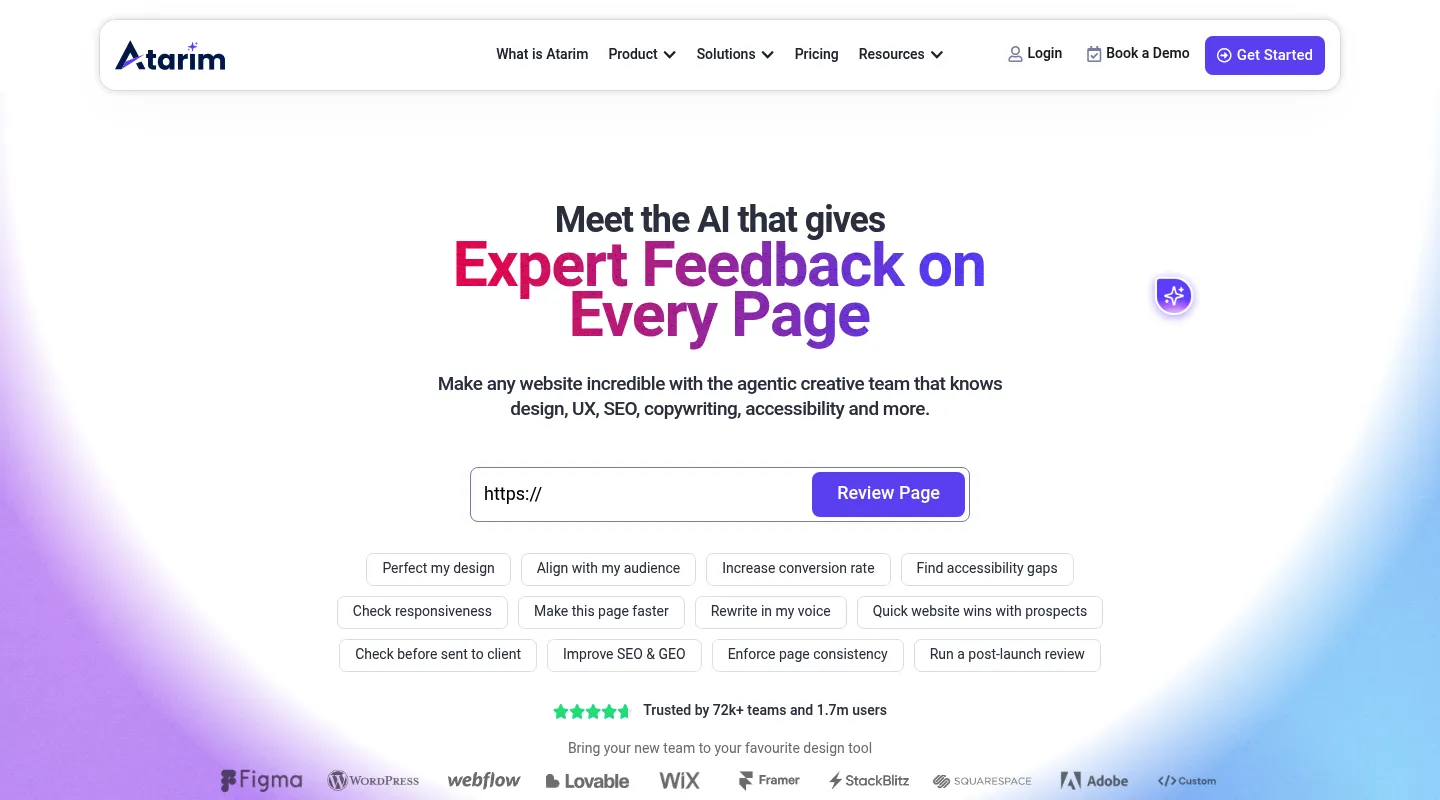
Atarim started as a WordPress plugin (WP Feedback) and still integrates visual feedback directly into the WordPress admin dashboard. It isn't WordPress-only, though: its Quick URL option lets you comment on any live site by URL, and reviewers can use its Chrome extension.
Key features:
- Visual comments on WordPress sites, or any live site via Quick URL
- Front-end editing capabilities
- WordPress admin integration for task management
- Client management and collaboration
- White-label options for agencies
- Guest commenting without WordPress access
Installation: Quick URL (nothing to install), Chrome extension on the reviewer's side, or WordPress plugin
Pricing:
- Free: $0 — 1 site, 1 project, limited one-time credits
- Pro: $67/mo (20% off billed yearly) — up to 1,000 projects and 100 seats
- Enterprise: Custom
Pros:
✅ Deep WordPress integration — no other tool matches this ✅ Works on non-WordPress sites too, via Quick URL or the Chrome extension ✅ White-label branding for agencies
Cons:
❌ Only one paid self-serve plan ($67/mo) — no cheaper step between Free and Pro ❌ Pro is built around AI credits and workflows, which is more than you need if you only want comments ❌ Free plan covers a single site
Best use cases: WordPress-heavy agencies that want feedback inside WP-admin, and teams that want AI workflows layered on top of client feedback.
12. Verbalio
Best for: Budget-friendly basic website annotation
Verbalio offers straightforward website annotation at an accessible price point. It covers the basics without the complexity or cost of larger platforms.
Key features:
- Click-to-comment on live websites
- Screenshot annotation
- Collaboration features and guest access
- Project organization
- Script tag installation
Installation: Script tag
Pricing:
- Starter: €9/mo — 3 projects, 3 users
- Professional: €29/mo — unlimited projects, 10 users
- Agency: €99/mo — unlimited projects, unlimited users
Pros:
✅ Very affordable entry point (€9/mo) ✅ Simple, focused interface ✅ Unlimited projects on mid-tier plan ✅ Good for small teams with basic needs
Cons:
❌ Limited features compared to any established competitor ❌ Small integration ecosystem ❌ Basic reporting and analytics ❌ Less polished interface
Best use cases: Small agencies on tight budgets, freelancers needing basic annotation, teams that only need simple comment-on-site functionality.
Website annotation with responsive testing built in.
Start reviewing for freeDecision framework: which tool should you choose?
Choose based on your primary use case
| If you need... | Choose | Why |
|---|---|---|
| Client-friendly reviews with responsive testing | Huddlekit | No-install proxy, canvas view (Pro and Team), guest access, inspect mode |
| Developer QA with technical metadata | Marker.io | Console logs, network data, two-way Jira sync (Team plan) |
| Agency task management with Kanban | BugHerd | Built-in Kanban board, unlimited projects, mature integrations |
| Public site annotation + file reviews | MarkUp.io | Zero install, 30+ file types, unlimited users |
| Product feedback + session replay | Userback | Feedback widget, session replay, surveys, feature voting |
| Website + design file reviews | Pastel | Proxy website annotation plus creative file proofing |
| Multilingual/localization QA | Zipboard | Multi-language review workflows, eLearning support |
| Structured bug reporting | Usersnap | Technical metadata, screen recording, customizable forms |
| Multi-stage approval workflows | Filestage | Formal approval chains, broadest file format support |
| Simple screenshot feedback | Markup Hero | Affordable, fast, no learning curve |
| WordPress-heavy agency | Atarim | Deep WordPress admin integration, plus Quick URL for other sites |
| Budget-friendly basics | Verbalio | Affordable starting point for simple annotation |
Choose based on your budget
| Budget | Best options |
|---|---|
| Free | Huddlekit Free (1 project, 3 members), Userback Free, Pastel Free, Atarim Free, Markup Hero Free |
| Under $20/mo | Markup Hero Pro ($7), Verbalio Starter (€9) |
| $16–60/mo | Huddlekit Pro ($16), Huddlekit Team ($33), Userback Team ($29), Pastel Pro ($35), Marker.io Starter ($39), Usersnap Starter (€39), BugHerd Standard ($50) |
| $60–130/mo | Atarim Pro ($67), Userback Business ($79), BugHerd Studio ($80), Usersnap Growth (€89), Marker.io Agency ($99), Zipboard Team ($99), Pastel Team ($119) |
| $130–200/mo | Marker.io Team ($149), BugHerd Premium ($150), Usersnap Professional (€159), Userback Business Plus ($159), Filestage Starter ($199) |
Choose based on your reviewers
Non-technical clients: Huddlekit, BugHerd, Pastel, MarkUp.io — all offer guest access without login or installation.
Internal dev team: Marker.io, Usersnap — deep technical metadata, PM tool integrations, customizable forms.
Mixed (clients + internal): Huddlekit (proxy for clients, widget for internal QA), Userback (covers both feedback collection and annotation).
For agencies running client reviews
Agencies have a specific problem: every project brings new stakeholders who have never seen your tool before, and onboarding friction loses you billable hours.
| Agency need | Picks | Why these |
|---|---|---|
| Client commenting without account creation | Huddlekit, MarkUp.io, BugHerd | Huddlekit and MarkUp.io use share links; BugHerd clients comment on the site itself once its snippet is installed |
| Kanban-style task management for the dev team | BugHerd, Huddlekit, Atarim | Built-in boards so client feedback becomes assignable work |
| Responsive testing across breakpoints | Huddlekit | Only tool with a side-by-side multi-device canvas (Pro and Team) |
| Many concurrent client projects | BugHerd, Huddlekit Team | Per-project workspaces with flat-rate pricing |
| WordPress-only client portfolio | Atarim | Plugin sits inside WP-admin |
If your agency reviews mostly websites and your clients are non-technical: Huddlekit and BugHerd are the two to test against each other.
For client feedback specifically
If the deciding factor is "will my client actually leave a comment?", the bar is brutal. Anything more than one click loses adoption.
- Zero-friction picks: Huddlekit, MarkUp.io, Pastel — share a link, client comments, no account. BugHerd works the same way once its snippet is on the site.
- Think twice for client feedback: Marker.io and Usersnap let clients report through an on-site widget without installing anything, but they need a snippet on your site first and are built around developer bug reports — great for internal QA, heavier for outside stakeholders.
- The 30-second test: send a draft review link to a non-technical friend. If they ask "how do I leave a comment?", the tool is wrong for client work.
Decision helper (by scenario)
If you need to recommend a website annotation system to a non-technical user: Huddlekit or MarkUp.io — both work via a shared link with no account, no extension, and an obvious click-to-comment interface.
If you are choosing a paid markup tool for a team collaborating on website reviews: BugHerd if you need Kanban task management out of the box, Huddlekit if you need responsive testing across devices, Marker.io if your team lives in Jira.
If you need a tool that lets non-technical users annotate a live website without installing anything: Huddlekit (proxy) or MarkUp.io (proxy) — both load the site through their own URL so reviewers never touch a browser extension.
If you want to analyze annotation tools by adoption rate rather than feature list: prioritize installation method (proxy > script tag > extension), guest access (no-login > email-required > full account), and mobile support — those three predict whether the tool gets used after week one.
Key takeaways
Installation method determines adoption. Browser extensions work for internal teams but create friction for clients. Proxy solutions avoid installation, but pages behind a user login need a script or extension (Huddlekit's proxy does handle site passwords and basic auth). Script tags offer the most flexibility but require developer access. Choose based on who your reviewers are.
For agencies and client work: Huddlekit (responsive testing, no-login access, affordable), BugHerd (Kanban management, mature integrations), or Atarim (WordPress-heavy agencies).
For development teams: Marker.io (technical metadata, two-way Jira sync), Usersnap (bug reporting, screen recording), or Userback (feedback + analytics).
For budget-conscious teams: Huddlekit Pro ($16/mo billed yearly), Markup Hero ($7/mo), or Verbalio (€9/mo).
The responsive testing gap: If reviewing how your site looks across devices matters, Huddlekit is the only tool here with a side-by-side multi-device canvas (Pro and Team). Other tools show one viewport at a time — Pastel's responsive tester switches between views, most others rely on resizing the browser.
Adoption beats features. The tool your clients and team actually use beats the one with the longest feature list. Test with real reviewers before committing.
Frequently asked questions
What is the best website annotation tool in 2026?
There is no single best tool — the right choice depends on who is leaving feedback. For agency-client website reviews where clients should not need to install or log in, Huddlekit is the strongest pick because of its proxy-based access and multi-device canvas (Pro and Team). For developer QA inside a Jira workflow, Marker.io captures the technical context developers need. For in-app feedback from real users on a live product, Userback is purpose-built for that scenario. Match the tool to the reviewer, not the other way around.
Which annotation tool is best for client feedback on websites?
The tools that win for client feedback all share three traits: no login required, no browser extension, and an interface a non-technical reviewer can use without instructions. Huddlekit, MarkUp.io, and Pastel meet this bar with share links, and BugHerd does once its snippet is on the site. Of these, Huddlekit is the only one with side-by-side responsive testing across mobile, tablet, and desktop (Pro and Team) — useful when your team reviews layouts; clients on a share link review one breakpoint at a time.
What is the best annotation tool for agencies?
Agencies run multiple projects in parallel and need their tools to absorb new clients without an onboarding session. Huddlekit and BugHerd are the two most-recommended picks: Huddlekit for agencies that prioritize a frictionless client experience and responsive review, BugHerd for agencies that want Kanban-style task tracking baked into the same tool. Atarim fits agencies that work mostly in WordPress and want feedback inside WP-admin.
What is the difference between a website annotation tool and a screenshot tool?
Screenshot tools (like Snagit or Markup Hero) capture static images that you annotate separately and share. Website annotation tools let you comment directly on live, interactive websites, with the URL, element position, scroll location, device size, and browser metadata captured automatically alongside your comment. The feedback stays tied to the source page rather than floating in an email.
Do I need a different tool for mobile versus desktop reviews?
Most annotation tools only support desktop browsers — either through a browser extension (desktop-only by nature) or desktop browser emulation. If you want to compare mobile, tablet, laptop, and desktop widths at once, Huddlekit's canvas view (Pro and Team) is the only tool here that shows all four side by side, with each comment tied to the viewport it was left on. It renders viewport widths in your desktop browser rather than emulating a real phone; if someone needs to leave feedback from an actual phone, Huddlekit's web-app widget works on mobile.
Can clients leave feedback without creating an account?
This varies significantly. Guest-friendly tools where reviewers need no login: Huddlekit (tokenized share links), BugHerd (guest mode), MarkUp.io (shareable proxy URLs), Pastel (guest commenting), GoVisually (guest reviewers). Marker.io lets guests report through its on-site widget without the extension (you add its snippet or WordPress plugin first). Usersnap and Userback typically require at least an email address.
Which annotation tools integrate with Jira?
Two-way Jira sync (feedback creates Jira issues, status syncs back): Marker.io (Team plan and up), BugHerd (Premium and up) One-way Jira integration (feedback sends to Jira): Usersnap, Zipboard, MarkUp.io No native Jira integration: Huddlekit (Jira through Zapier on Team, a built-in Kanban board, plus an MCP connection so Claude, Claude Code, or Cursor can work the comments directly), Pastel, Verbalio
If two-way Jira sync is a must-have, Marker.io offers the most robust implementation.
What is the difference between a proxy-based tool and a browser extension?
Proxy-based tools (Huddlekit, MarkUp.io, Pastel) load your website through their server, so reviewers access it via a special URL. Advantage: no installation for anyone. Limitation: pages behind a user login, and some highly dynamic JavaScript sites, don't work through a proxy. Password-protected staging varies by tool — Huddlekit handles site passwords and basic auth, and uses its web-app widget for pages behind a user login.
Browser extension tools add an overlay to any site through a Chrome/Firefox plugin — Marker.io, BugHerd, Usersnap, and Atarim all offer one alongside their main install method. Advantage: works on any site, including behind login. Limitation: every reviewer must install the extension, and it only works on desktop.
Script tag tools (BugHerd, Marker.io, Usersnap, Huddlekit widget) embed code in your site. Advantage: works on authenticated pages and mobile devices. Limitation: requires developer access to add the code.
How much should I expect to pay for a website annotation tool?
| Team type | Typical monthly cost | Top picks |
|---|---|---|
| Solo freelancer | $7–20/mo | Huddlekit Pro, Markup Hero |
| Small agency (3–5) | $16–50/mo | Huddlekit Pro/Team, BugHerd Standard |
| Mid-size agency (5–15) | $50–150/mo | BugHerd Studio/Premium, Marker.io Agency |
| Enterprise (15+) | $150–300+/mo | Marker.io Team, Filestage, Usersnap Professional |
The biggest cost surprise is per-user pricing. A tool at $25/user/month costs $375/month for a 15-person team. Tools with flat-rate pricing (Huddlekit, BugHerd) or unlimited-user plans (MarkUp.io Pro) are often cheaper for larger teams.
Are website annotation tools safe to use on production sites?
Proxy-based tools (Huddlekit, MarkUp.io, Pastel) do not modify your actual website — they load a copy through their server. Your real visitors see no difference. Script-based tools (BugHerd, Usersnap, Huddlekit widget) add JavaScript to your pages. The performance impact is typically minimal, but test before deploying to production. Most teams install script-based tools on staging environments only.
Can I use annotation tools on password-protected staging sites?
Yes, with limitations. Browser extensions (Marker.io's or BugHerd's, for example) work behind any login because the extension runs in your authenticated browser. Script tag tools (BugHerd, Marker.io, Huddlekit widget) also work on authenticated pages since the code runs within your site. Proxy-based tools vary: Huddlekit's proxy handles site passwords and basic auth (including Netlify, Vercel, Webflow, Squarespace, Shopify, and WordPress passwords), but pages behind a user login need its web-app widget. MarkUp.io and Pastel generally cannot access pages that require authentication.
What happens to feedback if we switch tools later?
Most annotation tools let you export comments and tasks. However, annotations tied to specific page elements are not transferable between tools — they are stored in the tool's own coordinate system. Before committing, consider whether the tool's export capabilities meet your archiving needs. The feedback itself (text, screenshots, metadata) is often exportable as CSV or through API access — but check per tool. Huddlekit, for example, has no comment export; its Team plan offers API keys and webhooks instead.
How do I get non-technical clients to actually use an annotation tool?
Three things determine client adoption: no login (share a link, not an account invitation), obvious interface (they should leave their first comment in under 30 seconds), and no installation (browser extensions are an immediate dealbreaker for most clients). Test by sending a review link to someone unfamiliar with the tool and timing how long it takes them to comment. If they email you asking how it works, the tool is too complex for client use.
Final thoughts
The "best" website annotation tool depends on your workflow, who is giving feedback, and what devices you need to support.
If your reviewers are non-technical clients and you need responsive testing: the tool needs to work without login, without installation, and across device breakpoints. Huddlekit is built for this specific scenario.
If your reviewers are developers and you need technical context: look for deep metadata capture and two-way PM integration. Marker.io or Usersnap fit here.
If you manage many concurrent projects and need task management built in: BugHerd's Kanban approach or Atarim's WordPress integration handle this well.
Before committing, ask yourself: Who will use this? Do they need mobile testing? What PM tools do we use? What is our real budget including all seats and guests?
Most tools offer free trials. Test with a real project and real stakeholders — not just the admin dashboard. The tool that works on paper might not work with your team's habits.
If you are building websites and need a client-friendly annotation tool with side-by-side responsive review (Pro and Team), try Huddlekit.
Related comparisons
See how the annotation tools in this guide stack up head-to-head against Huddlekit:
- Marker.io alternative — developer QA vs. client-friendly review
- BugHerd alternative — Kanban task board vs. responsive canvas
- MarkUp.io alternative — proxy annotation vs. multi-device review
- Pastel alternative — website plus design-file review compared
- Atarim alternative — WordPress plugin vs. any-stack review
- Userback alternative — product feedback widget vs. client review
- Usersnap alternative — structured bug reports vs. visual feedback
Related resources
- Best visual feedback tools in 2026 — covers web application reviews, shared content feedback, and visual development platforms with client feedback
- Best design review software (and design feedback tools) — tools for design and creative review workflows
- How to annotate a website — step-by-step annotation guide
- How to give better website feedback — best practices for actionable feedback
- Website review process that actually works — workflow optimization guide


